
MILESTONES / SPECIAL COMMEMORATIVE ISSUE / FALL 2026
BAILEY COLLEGE MILESTONE: 25 YEARS OF CAL POLY PIER
An Impactful Icon and New Era of Marine Science

Read this article in Spanish. Lea este artículo en español.
WRITTEN BY NICK WILSON
The pier has been the key to the expansion of learning opportunities and building our national reputation for being able to do marine science so successfully.
— Dean E. Wendt, Dean of Bailey College of Science and Mathematics
The morning of Nov. 29, 2001, didn’t look promising for a dedication of the newly acquired Cal Poly Pier stretching into the San Luis Obispo Bay in Avila Beach.
With a large gathering planned to celebrate the transfer of ownership from an oil shipping facility into an educational space, stormy weather threatened to ruin the big day.
After rain poured all morning, the skies fortuitously cleared just before the 2 p.m. ceremony, a beautiful rainbow enchanted guests, and a new era of marine science was born.

This fall marks the 25th anniversary of the Cal Poly Pier, a 3,000-foot-long concrete and steel platform used by students, faculty and industry partners to conduct a plethora of research and learning activities.
In 2024-25, the latest annual data, more than 1,100 students, 84 student researchers and 14 faculty researchers used the pier, a portal to the Pacific Ocean for marine ecology, aquaculture, scientific diving, conservation, wave energy testing and much more.
“The pier has been the key to the expansion of learning opportunities and building our national reputation for being able to do marine science so successfully,” said Dean Wendt, dean of the Bailey College of Science and Mathematics. “And it has become integrated across Cal Poly as a universitywide resource.”
Life at the Pier
Over the years since the pier’s acquisition, class instruction, marine science research and industry partnerships have grown significantly.

A typical day might find biology students cultivating native oysters or monitoring rockfish, octopi or sea urchins in aquarium tanks; student researchers adjusting tidal gauge equipment or an ocean chemistry team winching equipment to the deck to collect seawater samples. If they’re fortunate, they might be dazzled by breaching humpback whales or pods of dolphins passing by.
A premier research and teaching facility, the pier offers students unique ocean access. Located about 11 miles from the main campus in San Luis Obispo, the pier extends over a half mile into the bay with up to 40 feet of water depth below.
“The pier was one of the reasons I came to Cal Poly,” said Alexis Pasulka, a biological oceanography professor. “It provides an outdoor classroom that is accessible for teaching and research. It’s a giant science lab.”
Operating the Pier
Nikki Adams was hired as a new Biological Sciences Department faculty member shortly before the pier was formally acquired and recalls a beautiful dedication ceremony setting and a bright outlook for marine science education.

Over the past 25 years, Adams fondly recalls instructional lessons, experiments, spawning sea urchins and vibrant Open House events at the pier. Adams was the driving force in establishing a new marine science major in 2016.
“Sharing the wonders of marine creatures with our students in invertebrate zoology or with the public at Open House events, and seeing their surprise and excitement, fills me with joy,” Adams said.
Adams’ husband, Tom Moylan, then a marine researcher, attended the event in 2001, forming his first thoughts about the place that would become the focus of his work over the next quarter century.

“I remember being excited by the potential I saw for the facility to become a premier marine lab and thinking Cal Poly will need someone to manage the pier operations,” said Moylan. “Not long after, that position was posted. I applied and I’ve been at it ever since.”
Moylan’s versatile role as marine operations manager facilitates logistical and administrative needs for a wide variety of programs and people, including students, faculty, industry collaborators and guests of the annual Open House event that attracts between 1,500 and 2,000 visitors.
Moylan has fixed broken seawater filtration valves in the middle of the night, coordinated large groups of visitors and served as the lead project manager for all pier renovations, generally possessing a wealth of institutional knowledge.
“Because we have this incredible resource and direct access to the ocean, our mission has been to leverage those assets to advance our educational goals,” Moylan said. “It takes planning and creativity, but the pier is an invaluable resource for our students, faculty and research programs.”
Also instrumental in pier operations, Jason Felton, Cal Poly’s diving safety officer and boating safety officer, administers scientific diving and boating programs while also applying his knowledge of marine biology, field research techniques, and mechanical and computer systems to additional learning activities. Felton, who has served at the pier for the past 18 years, has trained students in diving since 2014 when he implemented Cal Poly’s inaugural Scientific Diving course.
“We spend a lot of time in the classroom, studying diving physiology, diving physics and decompression theory,” Felton said. “We get into the pool and conduct advanced drills, so that everybody is very comfortable with their equipment. We want to make these students such good divers that the act of scuba diving is second nature, and they can focus on the task at hand, whether that's installing oceanographic equipment, conducting subtidal surveys or collecting organisms for later study in the lab.”

And Bailey College’s Electromechanical Equipment Technician Rob Brewster of the past 10 years provides essential technical support, keeping the seawater system operational and maintaining vessels. Brewster’s work includes coordinating a remote system to monitor seawater filtration, maintaining electrical systems and adapting boats for research.
“We fabricate equipment and build it,” Brewster said. "My job is to design and fabricate specialized equipment that delivers practical solutions to unique operational challenges.”
From Industry to Education
Before the acquisition, Mark Moline, who came to Cal Poly in 1998, recalled an ongoing search to add a new Cal Poly marine education facility.

“What (late biological sciences) Professor Tom Richards and I both saw was just a big gap,” said Moline. “We were located smack in the middle of a large area that didn’t have any marine-related institutions from Monterey to Santa Barbara. Not having our students experience the ocean beyond a couple field trips needed to be rectified.”
But the idea of taking over an industrial structure used to ship petroleum since the 1920s wasn’t clear cut, at least initially. Over the lifetime of petroleum transport at Avila Beach, significant ground contamination from pipe leakages occurred, as well as a pipeline break on Aug. 3, 1992, spilling 24,000 gallons of crude oil into the Pacific Ocean. Unocal, the pier owner at the time, ceased its operations in the mid-1990s. Amid mitigation efforts, Cal Poly students conducted analytical work monitoring the cleanup as part of a Unocal contract with the university. That led to discussions about transferring ownership.
Phil Bailey, then dean of the College of Science and Mathematics, and former Cal Poly President Warren Baker, carefully considered whether to acquire the pier, ultimately deciding in favor.
“It took a significant amount of negotiation and deliberation, knowing this was a major responsibility,” Bailey said. “The pier acquisition was a time-consuming and important part of my life at the time.”

Over the next several years, reshaping the structure for educational use transformed the facility to now include: a classroom/dry lab, a second-floor conference room with 360-degree views of San Luis Obispo Bay, a flowing seawater system with wet-lab and aquarium space, four boats (including its marquee 26-footer, the TL Richards, named after the late professor) and an upgraded below-deck platform with direct ocean access. The pier also supports various monitoring instruments, including a meteorological station.
Moline served as the first director of Cal Poly’s Center for Coastal Marine Sciences (CCMS), established in 2003.
“Besides adding specialists in marine-related biology, I sought to involve other departments in physics and engineering to study questions on erosion, wave action, sea level rise and big climate issues,” Moline said.
Growth of Marine Science Education and Research
After Moline took a new position at the School of Marine and Science Policy at the University of Delaware, Wendt took over the CCMS director role between 2012 and 2017, further expanding the multi-disciplinary program with students and classes including biology, engineering, architecture and physics.
“Because of the facility, we now had a resource around which we could build faculty expertise and really start building community connections,” Wendt said. “What started with four faculty in the biology concentration of marine sciences grew significantly largely because of the pier’s addition to Cal Poly.”
An $11.2 million donation from the Santa Rosa Creek Foundation established in 2021 supports student scholarships, research, fellowships, training and more over an ongoing 10-year period.

Over the years, faculty-led research studies have involved students in a wide range of projects. To name a few, Royden Nakamura studied marine protected areas and fish tagging; Moline deployed autonomous underwater vehicles and high-frequency radar to map and monitor aquatic environments; Adams examined effects of toxicants (e.g. plastics) on the reproduction and development of local sea urchins, Wendt conducted extensive research on developing non-toxic, foul-release marine coatings through a 25-year grant with the Office of Naval Research (now run by Adams); Sean Lema, a biological sciences professor, has explored growth rates of rockfish; and Ryan Walter, a physical oceanographer, has studied marine heatwaves and cold spells along the California coast.
Research on harmful algae blooms has been ongoing at the pier since 2008. And long-term studies assess ocean acidification that can affect fish, plant and human health.
“In addition to weekly harmful algal bloom monitoring, the pier has a nearshore station that measures things like temperature, salinity and chlorophyll fluorescence.” Pasulka said. “Every 30 minutes, an instrument collects a profile of the water column, giving us a continuous picture of how the ocean conditions are changing.”
Time-series data collections provide a window into how marine ecosystems are responding to environmental changes. Students learn sampling techniques, build leadership skills and practice data interpretation.
“The pier really allows us to have hands-on experiences, to study tiny organisms, which are not on the forefront of our minds, but have these profound effects on the ocean ecosystem and our public health,” said Sydney Yium (Biological Sciences, ’26).
A Blue Economy

The pier also supports economic activities associated with the ocean, also known as the blue economy, including wave energy testing.
The Testing Expertise and Access to Marine Energy Program (TEAMER) partnership, established in 2025 at Cal Poly, offers approved collaborators pier access to test devices and systems. CCMS hosted a TEAMER summit this summer of representatives from national laboratories, universities, nonprofits and private companies.
“We have a few projects in the queue to bring companies to the Pier who are leading this cutting-edge work. These projects increase our connections to these organization and help develop clean, sustainable technologies," said current CCMS Director Ben Ruttenberg. “This provides amazing opportunities for our students to interact with and learn from the leaders in this field, while developing their professional networks to launch their own careers.”
Additionally, Kevin Marquez Johnson, an aquaculture specialist with the California Sea Grant Extension program, collaborates with students and local companies to develop industry-relevant research. That includes work to cultivate the Olympia oyster, California’s native oyster, versus the more commonly marketed, non-native Pacific oyster.

“Over the past four years, we’ve produced about 25,000 Olympia oysters, which go from living at the pier to aquaculture farms in Morro Bay,” Johnson said. “The goal is for the farmers to be able to produce a commercial product, while also adding environmental restoration benefits.”
And students like Connor Healy, a diving operations officer for the Dive Center of the National Oceanic and Atmospheric Administration, found their calling in Cal Poly’s inaugural Scientific Diving course. Scientific Diving, taught by Jason Felton and Kaitlin Johnson (M.S., Biological Sciences, ’16), was launched in 2014.
“My learning experience at Cal Poly is still one of my greatest experiences in diving education,” said Jason Healy (Biological Sciences, ’15). “The instructors put us through a very well-designed and rigorous course.”
Ruttenberg said the pier is a critical component to helping find ways that the oceans can be not only solutions to the climate crisis but also provide sustainable jobs and help build new industries.
“The pier gives us access to the marine environment in ways that few other places do,” Ruttenberg said. “It allows us to provide access to so many more projects and programs than otherwise would be possible.”

Support Future Generations of Learn By Doing at the Cal Poly Pier
The Land and Waters on Which We Learn
Where Cal Poly Pier is situated carries the heritage and culture of the Indigenous people of yak titʸu titʸu yak tithini, Northern Chumash tribe. We acknowledge that we live and work on their unceded land and waters.
Long before European explorers anchored in its harbor and before Don Miguel Avila was granted its acreage, this area was known by yak titʸu titʸu yak tithini as tsɨtpxatu — Place of the Whales. The ytt Northern Chumash were the first to understand, appreciate and respect the important environment and rich wildlife of the Central Coast.

We are born with the responsibility of caring for the natural world. The natural world must thrive, so that mankind will survive.
— Mona Olivas Tucker, Chair, yak tityu tityu yak tiłhini Northern Chumash Tribe, San Luis Obispo County and Region
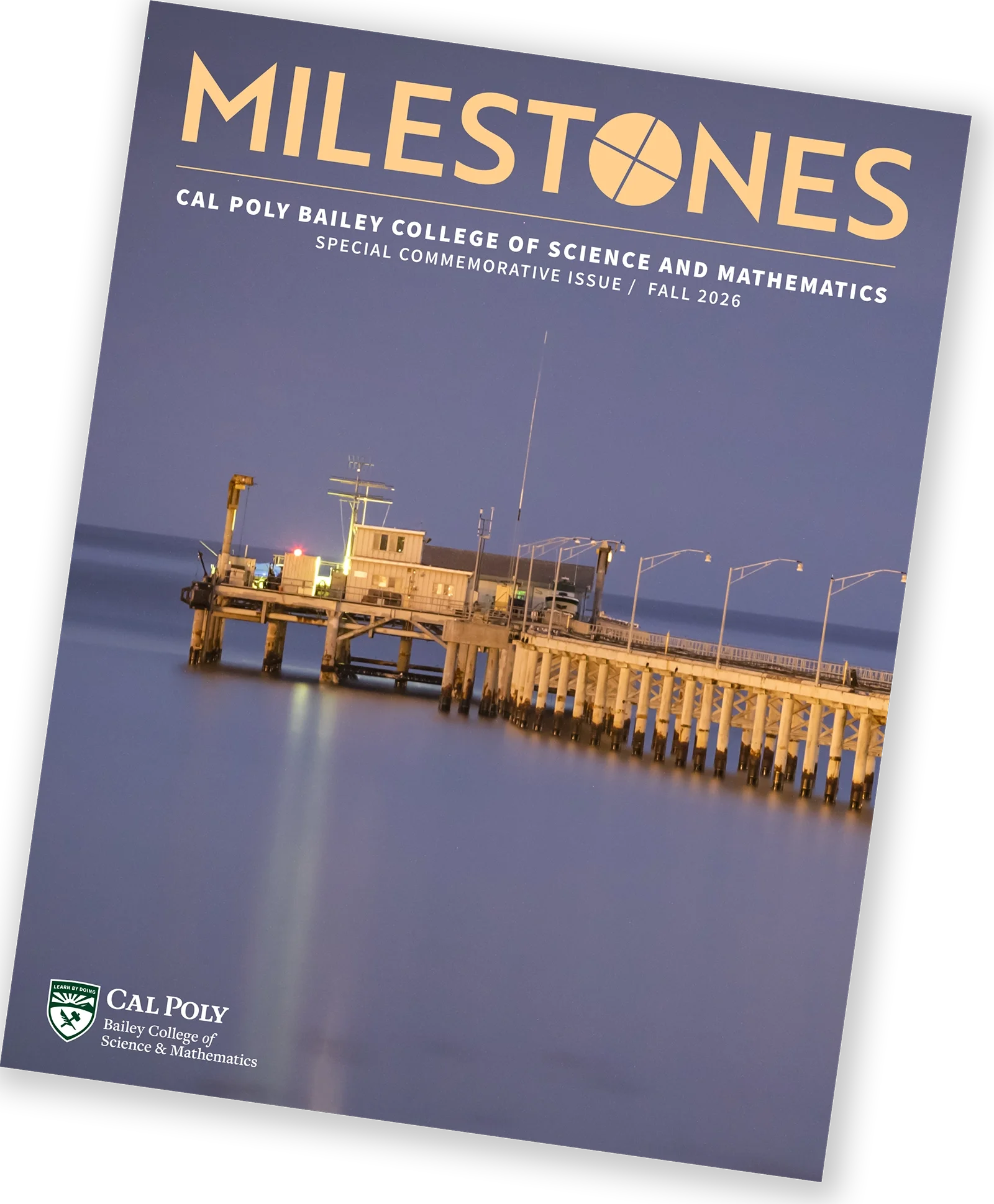
Explore the Full Issue
Published as part of Milestones, a special commemorative issue magazine from the Cal Poly Bailey College of Science and Mathematics in 2026.