
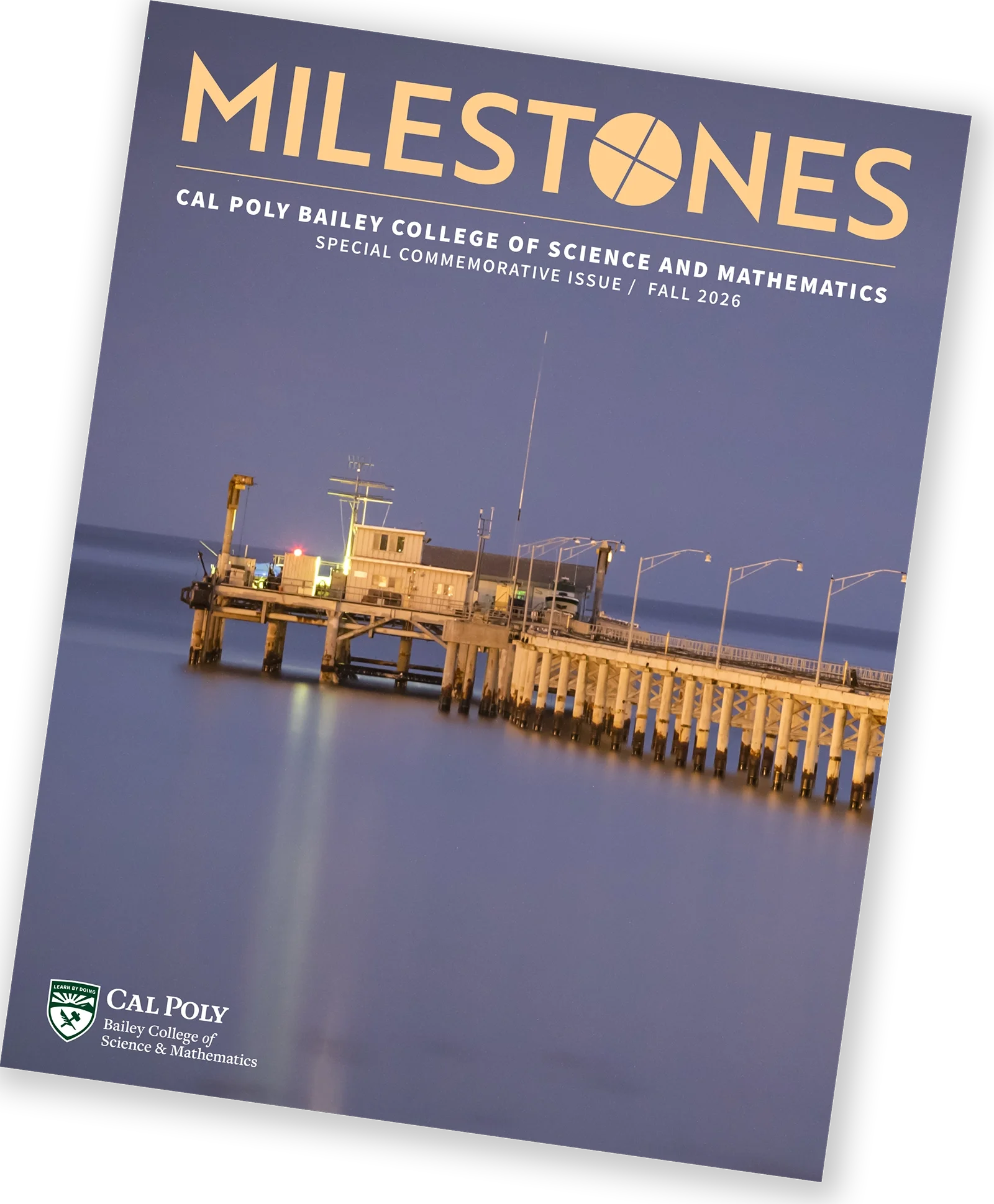
MILESTONES / SPECIAL COMMEMORATIVE ISSUE / FALL 2026
BAILEY COLLEGE MILESTONE: 10 YEARS OF FROST FUND
Frost Legacy: The Transformation of a College, Research and Countless Lives

When Phil Bailey first met Bill Frost in 1970, the two men weren’t far apart in age. Bailey was a new 26-year-old chemistry assistant professor, and Frost was a 21-year-old incoming transfer student in biochemistry, bringing with him a small grant to work on novel wastewater treatment concepts.
Frost’s research and Learn by Doing course experiences at Cal Poly helped spark his curiosity for working through problems and developing solutions.
Nearly six decades later, Bailey is now a dean emeritus and the William and Linda Frost Fund director. Bill and Linda Frost were among the joyful crowd in 2023 when it was announced that the College of Science and Mathematics was being renamed in honor of Bailey and his late wife, Christina Bailey, an influential Cal Poly chemistry professor and department chair.
Cal Poly gave me so much of what made me successful, and I really think that deserves a lot.
— Bill Frost, (Biochemistry, ’72)
Frost, who founded Paso Robles-based Chemlogics, sold the chemical manufacturing company in 2013. Subsequently, in 2017, Bill and his wife, Linda, made the largest donation in the history of the California State University system. The purpose, as stated in the gift agreement, is to maintain the Bailey College of Science and Mathematics “as outstanding and nationally recognized in undergraduate academic and student research programs.”
Bailey and Frost remain close friends who have worked closely to support thousands of Cal Poly students through the immensely impactful endowment, the Frost Fund, which celebrates its 10th anniversary this academic year.
“We’d kept in touch over the years, and Bill told me that he wanted to do something significant to support undergraduate research in the College of Science and Mathematics,” said Bailey, who now serves as director of the Frost Fund. “When we began having conversations, he said ‘Phil, I did not come from wealth. I’m giving a significant portion of my life’s work. It’s important that what we do is meaningful.’”
At an April luncheon with a group of Frost-funded research students, Bill Frost said: “Cal Poly gave me so much of what made me successful, and I really think that deserves a lot.
Frost Impact
The Frosts began contributing to Cal Poly nearly 25 years ago, when they funded the first student scholarship, supporting Libby MacKinnon, a double major in chemistry and mathematics.
MacKinnon, who attended Cal Poly between 2002 and 2007, now is an actuary working for the financial consulting firm, Milliman, living with her husband and two small children in Omaha, Nebraska.

“I still think fondly of my time at Cal Poly and appreciate the Frosts for their support for all five years I spent in San Luis Obispo,” MacKinnon said. “The Chemistry Department especially was like a family.”
From their initial individual gift, the Frosts gradually increased their support, leading to the formal establishment of the Frost Fund endowment. Each year, now about 40 students receive Frost scholarships (typically $10,000 annually) that allow them to focus on academics and undergraduate research. Each summer, more than 200 students receive significant stipends (typically $4,500) to engage in full-time research with faculty mentors through the Frost Summer Undergraduate Research program, and many more students are supported by grants obtained by the faculty, along with donations.
The Frost endowment provides support to cover costs associated with allocating faculty time to research, travel expenses and learning spaces, as well as the latest in equipment and instrumentation.
The Frosts were the lead donors for the 102,000-square-foot, four-story William and Linda Frost Center for Research and Innovation, located in the heart of campus, which opened in May 2023, with advanced labs, classrooms and research spaces.
Every year, more than half of Bailey College students engage in student-faculty research and almost every student in the college has benefited from the Frost Program through undergraduate research or instrumentation purchased by the Frost endowment for research that is also used in upper-division classes. The Frost Center provides the necessary space for this large amount of research activity to continue year-round. Frost-funded students present their work nationally and even internationally.

Publishing work in peer-reviewed journals as an undergraduate is a rare accomplishment at most universities; just in the past 10 years, nearly 1,100 undergraduates in the Bailey College have coauthored academic articles.
“This amazing impact has been transformational and truly has changed the way we educate our students,” said Dean Wendt, dean of the Bailey College. “The Frosts’ gift has elevated research across the entire college so that all students and faculty can participate. It wasn’t that research-based studies weren’t occurring before. It just wasn’t systemic in the way that it is now.”
Research Builds Skills
Students across Bailey College academic disciplines who participate in Frost research learn fundamental skills to investigate, innovate and inquire. Work by research teams includes applying scientific methods in chemistry or physics lab experiments; using computer programming tools in statistics; observing phenomena in biology; vetting theories in physics; formulating models in mathematics; and conducting surveys in public health.

“I learned many biochemistry, molecular biology and microbiology lab techniques, as well as experimental design and data interpretation,” said Sam Catania (Biochemistry, ’26), a Ph.D. student in chemical biology, biochemistry and biophysics at UC Santa Cruz. “The research experiences I gained through the Frost program helped me to feel confident that a Ph.D. is the right next step for me and gave me the skills and experience necessary to be a competitive applicant.”
Danielle Champney, a Frost mathematics faculty mentor, said student researchers grow through intensive study experiences.
“In theoretical math research, we require students to read papers they’ve never read before to think deeply about math problems and figure out where results might apply,” Champney said. “Applied math students may seek to figure out how to use math to solve real-world problems and use existing data sets and strategies. And others study how people learn math, from elementary to college-age students, thinking about how people make sense of problems and use visual representations, so that we can become better teachers.”
Research offers students the chance to pursue work that inspires them as they collaborate with dedicated faculty, helping them determine a career path.
A study led by physics Professor Ben Shlaer with undergraduates including Diego Dal Mas, a third-year physics major, seeks to determine if black holes can be mimicked by non-singular objects (versus the famous theorem by Roger Penrose stating that all black holes must have singular centers or places where the gravitational force becomes infinite).
“This research lets me do something that has always interested me and drawn me into physics,” Dal Mas said. “The skills involved are pretty philosophical where we need to learn how to actually think about the problems and use the equations and math to our advantage. I have already started using mathematical tools I never knew existed.”
For many, the Frost program is their initiation into a potential professional pathway or graduate degree program.
“To be admitted to a Ph.D. program, it’s extremely important to have undergraduate research experience,” Wendt said. “As a Cal Poly student (between 1989 and 1993), I had to leave campus to conduct research. Now, our students do not have to do that with all of the opportunities right here at Cal Poly.”
Student Success
The numerous personal stories of students benefiting from the Frost program offer a window into the impact of mentorship.

Veera Panova (Chemistry, ’20) studied the de-icing polymers, (a process commonly used in aviation to melt ice or frost from an aircraft) with Erik Sapper, a chemistry professor, through the Frost program as a second-year student. Panova learned how to formulate hypotheses, design experiments, and collaborate with other students in the group.
Panova’s career path has included a role as an associate chemist at Northrop Grumman before earning a Ph.D. in materials science and engineering at Massachusetts Institute in Technology. Currently, Panova is a materials engineer at SpaceX, where she develops both new alloys and polymers.
“All of my experiences at Cal Poly laid a solid foundation for my career,” Panova said. “I was able to apply the concepts we learned in chemistry classes to real-world problems in the lab, receive an introduction to polymers and metallurgy, work across disciplines, and collaborate with so many talented students. The Frost Scholarship enabled my college education, and I can’t thank Bill and Linda enough for such a transformative gift.”
Brooke Wallasch (Biological Sciences, ’24, M.S. Biological Sciences, ’25) cherished her research opportunities in Yosemite, studying under biological sciences Professor Dena Grossenbacher.

Supported as a Frost Research Scholar, Wallasch backpacked to remote hillside locations in the national park to establish new monitoring plots to record data and better understand how climate change may affect alpine plants. Wallasch continued the Yosemite work as a Cal Poly master’s degree student while training undergraduate students who were also supported by the Frost program. Now, Wallasch is pursuing a Ph.D. in evolution, ecology and organismal biology at UC Riverside.
“The most exciting thing about my research is being part of a forward-thinking project that is collecting data that will inform future management of alpine vegetation in Yosemite,” Wallasch said. “I am so thankful Dr. Grossenbacher took me under her wing while I was an undergraduate. I’m also thankful to Dr. Phil Bailey, who encouraged me to pursue grad school while I was in the Frost Research Scholars program.”
In summer 2026, Frost students such as statistic major Lin Khant, who collaborated with Professor Kevin Ross, applied what they learned in class to real-world problems. Their research group worked to overhaul programming code for probability simulations to model, test and predict the outcomes of random processes.
“I’ve never really had any prior experience with research, but I feel like this is kind of what Cal Poly is about,” Khant said. “I believe I’m being able to develop my abilities and skill sets for real-world uses.”
Connection and Community
Throughout the academic year and into the summer, Frost students connect with faculty, fellow students and research partners.

“The quarterly Frost meetings brought students together with faculty and the Frosts, who asked about our academic interests and career goals, and gave advice and support,” said Jenna Landy (Statistics, ’20). “Although I was a bit nervous at the time, these events helped me feel more confident when I interviewed for internships and eventually for Ph.D. programs.”
Landy earned a Ph.D. in biostatistics from Harvard University in November 2025. She then started a new job in January at the global pharmaceutical company Johnson & Johnson in discovery statistics, developing statistical methods and analyzing genomic data from lab experiments and clinical samples to help discover new treatments for disease. Landy applies her knowledge in open-source software and computation skills, citing her Cal Poly education, which included a minor degree in data science, as “immensely useful” in her career.
These opportunities will be here for your children, grandchildren, great-grandchildren and beyond. Always remember, Cal Poly was your launching pad to the future.
— Bill Frost, Cal Poly Commencement remarks, June 2026
Successful Frost Scholar alumni are well represented in many fields, including academia, medicine, genetics, data analysis, chemistry, bioengineering, materials science and more.
In his June 2026 Cal Poly Commencement speech, Bill Frost said: “These undergraduate research opportunities, which many of you have enjoyed, are endowed into perpetuity and will be here for your children, grandchildren, great grandchildren and beyond. I assume they will all want to come to Cal Poly. Always remember, Cal Poly was your launching pad to the future.”

Explore the Full Issue
Published as part of Milestones, a special commemorative issue magazine from the Cal Poly Bailey College of Science and Mathematics in 2026.