
From the Managing Editor, Eileen Odanaka Vavra
In 2014, the College of Science and Mathematics began publishing Intersections magazine at the start of each academic year. With the many meaningful and exciting activities and accomplishments by students, faculty, staff and alumni, it was clear these stories needed to be shared.
While planning this year’s issue, we began to see a trend — a lot of groundbreaking firsts and big anniversaries, including Cal Poly’s 125th. It became clear these stories needed to be shared in a special edition with a focus on milestones.
A milestone can be a useful marker. It can also be a weighty responsibility and a journey of effort when striving to reach one. Ah, but once reached, it’s time to celebrate.
In Milestones, we invite you to celebrate with us as we highlight momentous achievements and landmark anniversaries — accomplishments realized thanks to the hard work and vision of dedicated and talented people in the Bailey College of Science and Mathematics.
Cal Poly Maritime Academy Department, Program and Faculty Integration Completed

The Bailey College is thrilled to have completed the integration process of our newest department, adding to our family from Cal Poly Solano Campus the Oceanography and Natural Sciences (OcNS) Department, the oceanography degree program and chemistry and physics faculty.
The oceanography degree program stands out with its immersive, hands-on and unique learning environment. Students are taught the theories behind oceanography while gaining direct experience through fieldwork, lab analysis and the use of modern oceanographic instruments.
Just as the Cal Poly Pier provides unmatched opportunities to our San Luis Obispo-based marine science students, the San Francisco Estuary serves as a natural laboratory for Solano-based oceanography students. Oceanography students are often on the ocean conducting vessel-based sampling, small-boat operations and research in diverse coastal and estuarine environments.
The program nurtures a close-knit, collaborative community where students work alongside faculty on real-world ocean science problems. In true Bailey College and Learn by Doing style, oceanography majors benefit from individualized mentorship and required internships that build professional skills and connections within the field.
Because of its Bay Area location, oceanography students on the Solano campus have access to a wealth of options in ocean technology, government, environmental management and research. The curriculum emphasizes global perspectives, with students engaging in international experiences and offshore research — such as voyages to Hawaiʻi — broadening their understanding of marine systems worldwide.
Maritime has given me so many different opportunities as an oceanography major, from practicing data collection and getting sea time aboard our vessels, to authoring and clearly presenting research to the scientific community.
— Luca Gutcher, Oceanography student at Cal Poly Maritime Academy

Oceanography students Mario Matteoli and Gianna Chacon, aboard the research vessel Questuary, work to complete weekly surveys of the phytoplankton spring bloom in the San Francisco Estuary in 2026. Photo by Joe Johnston

Professor Matthew Fairbanks leads engineering students through exercises in his physics laboratory. Oceanography and Natural Sciences Department faculty support all degree programs through foundational STEM classes at the Solano campus. Photo by Eileen Odanaka Vavra

Oceanography student Ryan Wallace, aboard the research vessel Questuary. examines a sample collected for dissolved oxygen analysis. Photo by Joe Johnston
Center for Health Research Celebrates 20 Years of Broad Impact
2026 marks 20 years of the Cal Poly Center for Health Research. What began in 2006 as an idea among Kinesiology Department faculty to develop a center devoted to obesity prevention and education has grown into a formally chartered university center with a national and international research footprint.
Across two decades, three names and a widening research agenda, the core purpose of the center has held steady: to support rigorous, transdisciplinary research that improves health in our communities and beyond.

Biological sciences student Molly McNulty (left) and Frost Research Scholar and public health student Neida Palacios with frozen samples in a Frost Center lab. Photos by Nick Wilson

Biological sciences student and BEACoN Research Scholar Yaneli Alcantar presents her research poster to public health Professor and Center for Health Research Center Director Alison Ventura.
Cal Poly’s First CRISPR-Engineered C. elegans
Nobel Prize-winning gene-editing technology, CRISPR-Cas9, is now being used at Cal Poly to engineer the C. elegans genome. Through the expertise of newly hired biological sciences Professor Celja Uebel, the William and Linda Frost Fund has purchased the university’s first complete microinjection system, enabling the precise delivery of genome engineering reagents into cells.
With this set of state-of-the-art instruments, Uebel and her team of undergraduate researchers will use the new microinjection system to edit the genome of C. elegans, a microscopic roundworm that serves as a powerful model organism. The Uebel Lab aims to understand the molecular mechanisms that enable reliable genome inheritance during sexual reproduction.

Caenorhabditis elegans roundworms, a tiny, free-living soil nematode that is widely used as a model organism in biology, are moving on an agar plate in a lawn of bacteria. Courtesy photos

Sutter Instruments P-1000 micropipette puller.

Close-up of an injection needle connected to a Narishige MN-151 micromanipulator that is part of the Tritech Research MINJ-1000 complete microinjector system.
Coldest in the Universe and First of Its Kind
Excitement is on the rise while temperatures drop in the Ultracold Atoms Lab, an undergraduate research team led by a wife and husband faculty duo and physics Professors Hyewon and Joseph Pechkis.
The group seeks to create a quantum degenerate gas known as a Bose-Einstein condensate — the coldest stuff in the universe and the first of its kind at a public undergraduate institution.
The researchers shine six laser beams on atoms to cool them to temperatures at a millionth of a degree above absolute zero where behave like waves due to quantum physics. Next, lab members evaporatively cool these atoms a thousand times colder, creating a macroscopic matter wave exhibiting the atoms true quantum nature. These experiments may one day lead to novel interferometers with sensitivity below the quantum noise limit.

Physics student and Frost Scholar Hannah Reilly (’26) constructing the optical setup for the magneto-optical trap to laser cool atoms. Courtesy photos

Ultracold atoms in an ultrahigh vacuum science chamber are collected and cooled in a magneto-optical trap formed by three pairs of counter-propagating laser beams where they will be cooled to a millionth of a degree above absolute zero to create a quantum gas.

Mechanical engineering student Devanish Patel tests the mechanical shutter drivers for switching of the laser beams.

Image of ultracold atoms in the science chamber taken using absorption imaging.

Ultracold atoms are first cooled and collected in a source chamber and then transferred to the science chamber through a 750 micron aperture.
Liberal Studies Bachelor’s Pathway Program Welcomed Its First Cohort

Cal Poly and Cuesta College celebrated the launch of the Cal Poly Liberal Studies Bachelor’s Pathway Program and welcomed its inaugural student cohort with a kickoff reception in August.
The new pathway allows students to work toward a Cal Poly bachelor’s degree in liberal studies by completing Cal Poly coursework at Cuesta College in a cohort-based setting. Courses are scheduled to support students balancing their education with work, family and other responsibilities.
Students enrolled in the pathway are Cal Poly students. As Cal Poly Mustangs, they have access to Cal Poly academic advising, library resources, career support and other university services, as well as select resources available through Cuesta College.
The program is designed to expand access to a Cal Poly degree and prepare students for careers in education.
New Degree Program and Interdisciplinary First
Students will have a new academic path to follow at Cal Poly — data science. In August, the California State University Chancellor’s Office officially approved the new bachelor’s degree, with the first undergraduates to be enrolled in fall 2027.

The data science program is a first at Cal Poly, offering a cross-disciplinary major and degree to both prospective and current students. The 120-unit program will be jointly operated by the Bailey College of Science and Mathematics and the College of Engineering, tapping into expertise from both colleges to design its curriculum.
As an interdisciplinary field, data science combines statistics, computer science, mathematics and domain knowledge to extract insights from complex and unstructured data. Data science students will use programming, statistical modeling, machine learning, visualization and data management techniques to identify patterns, make predictions and address real-world problems. The data they’ll translate into evidence can support informed decision-making across fields such as technology, healthcare, business, finance, government, science and engineering.
Climate Conference Is Five Years and Counting
What began as a two-day online gathering has expanded to the Climate Solutions Now Conference as a five-day, all-virtual event. The conference convenes leaders, practitioners, educators, students and innovators from across sectors to advance real-world solutions to the climate crisis, with a focus on turning knowledge into action faster, fairer and at scale.

Through scheduled talks and discussions across parallel tracks, the conference creates space each year for deep learning, cross-disciplinary collaboration and practical engagement. Tracks include Environmental Justice, Policy, Water and Oceans, Agriculture, Energy, Built Environment, Business Sustainability and more.
Participants explore cutting-edge approaches to carbon emissions reduction, climate adaptation and resilience, while discovering ways to contribute based on their unique skills, interests and professional backgrounds. The program also highlights current and upcoming Learn by Doing opportunities for students and faculty working in climate change and sustainability.
Hosted by the Initiative for Climate Leadership and Resilience, Climate Solutions Now is designed to energize communication between scientists, engineers, policymakers, entrepreneurs, educators and community practitioners to bridge silos, accelerate impact and advance more equitable and effective climate responses.
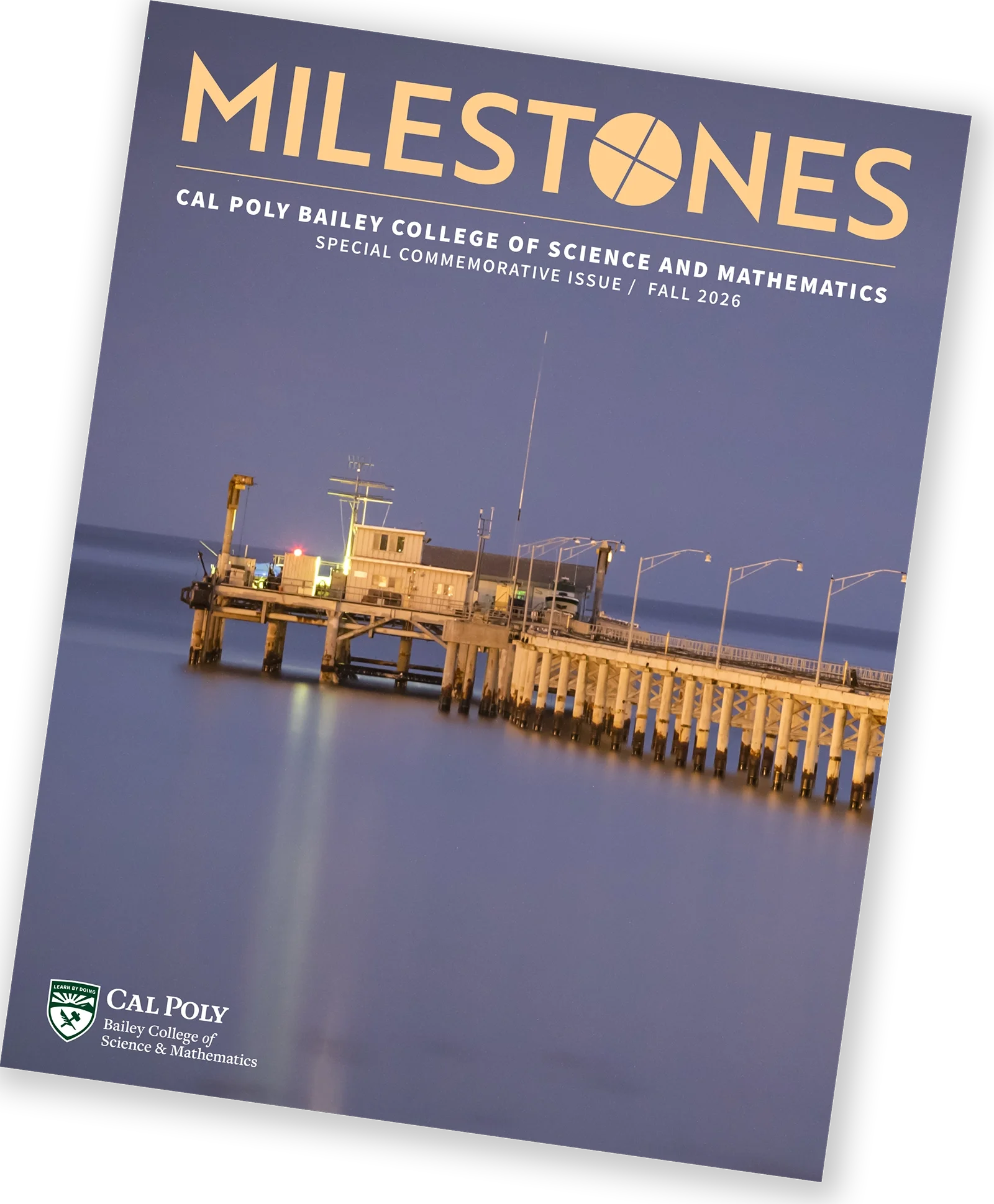
Explore the Full Issue
Published as part of Milestones, a special commemorative issue magazine from the Cal Poly Bailey College of Science and Mathematics in 2026.