
Whale Chat and Travel? Bioacoustics Data Can Provide Insight
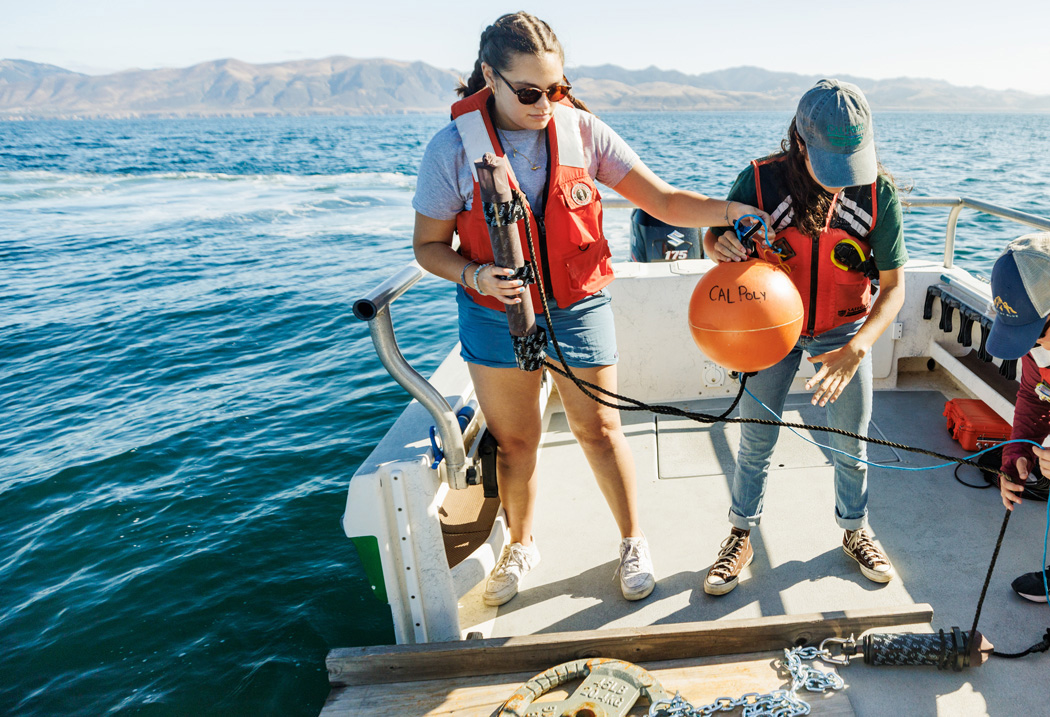
Cal Poly marine sciences, statistics and biological sciences researchers team up for multi-year study in central coast waters.
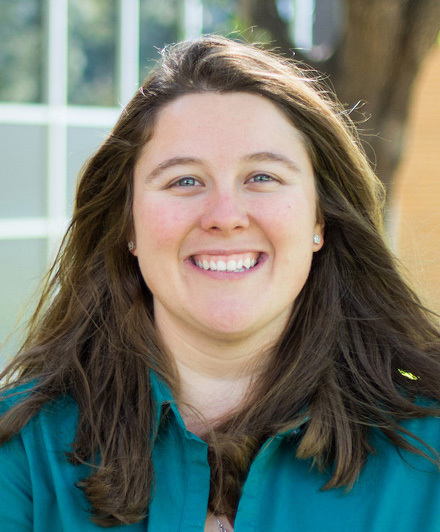
Many whale species travel in pods and use acoustic cues for navigation and social purposes. Maddie Schroth-Glanz, a Cal Poly statistics faculty member, is leading a multi-year bioacoustics study of the massive mammals off California’s Central Coast in coordination with Heather Liwanag, a professor of biological sciences.
We're trying to see how species presence changes over the course of a year and what kind of vocalizations they are making.
—Maddie Schroth-Glanz
Stastistics lecturer
The researchers are tracking noises emanating from whales using a hydrophone — an underwater microphone that detects and measures sound waves — situated in the Pacific Ocean at approximately 160-200 feet of depth about 3.5 miles off the Port San Luis coastline.
“We hope to help contribute to knowledge of what is out in our local waters based on what we can hear,” Schroth-Glanz said, noting that not a lot is currently known in this area. “We're in the infancy of a long-term data study to identify whale species, types of vocalizations, and eventually compare the year-to-year variability in these vocalizations.”
The research team is collecting data in hopes of confirming the documented migratory routes and activity of humpback and gray whales through the coastal waters. Fourth-year marine sciences students and Frost Research Fellows Adelle Wilkin and Sophie Short are part of the research team recording 96,000 sound samples per second. Rockfish and ship noises are among the sounds that must be distinguished from whale and dolphin acoustics.
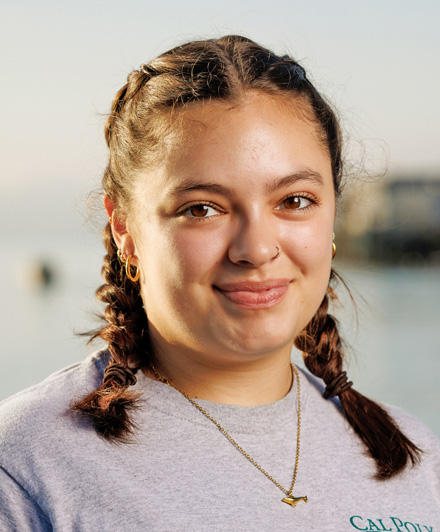
"Our biggest goal is to identify when the detections occur so that we can talk about what we're hearing," Schroth-Glanz said. "As we currently only have one listening device with no supplemental visual surveys, we are taking advantage of published visual data from whale watching companies to confirm when the whales are present in the area of our hydrophone.”
The ocean is a lot more complex and beautiful than what we see on the surface.
—Sophie Short
Marine sciences student and Frost Research Fellow
Schroth-Glanz said she hopes that publication of information in databanks will help scientists track migrations and better understand any changes taking place year over year, providing information for marine biologists and others to better understand any changing ocean and biological conditions.
“We're trying to see how species presence changes over the course of a year and what kind of vocalizations they are making,” Schroth-Glanz said.
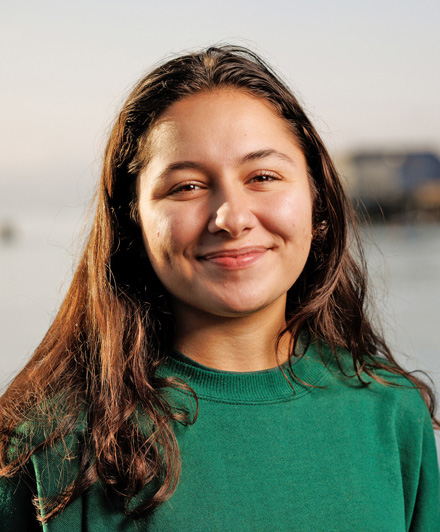
The research study is supported by the William and Linda Frost Fund, the Santa Rosa Creek Foundation, and CSU Council on Ocean Affairs and Technology grant funding.
The National Oceanic and Atmospheric Administration (NOAA) frequently produces stock assessment reporting on marine species in certain locations.
“I'm hoping that our data can provide more insight to people who create that NOAA report and other similar documentations," Schroth-Glanz said.
Working on this project has given me insight into the magnitude of marine mammals’ complexity that only bioacoustics can provide.
—Adelle Wilkin
Marine sciences student and Frost Research Fellow
"Listening in on charismatic humpback whales’ song or enigmatic gray whale communication has truly been a dream come true," said Wilkin. "Working on this project has given me insight into the magnitude of marine mammals’ complexity that only bioacoustics can provide."
"The ocean is a lot more complex and beautiful than what we see on the surface. While it's always exciting to go whale watching and see humpbacks breach and lunge feed, it does not compare to listening to the hauntingly beautiful whale songs," said Short. "Listening to these animals' vocalizations and songs feels like such a privilege and I am grateful to be working on a project that studies them."
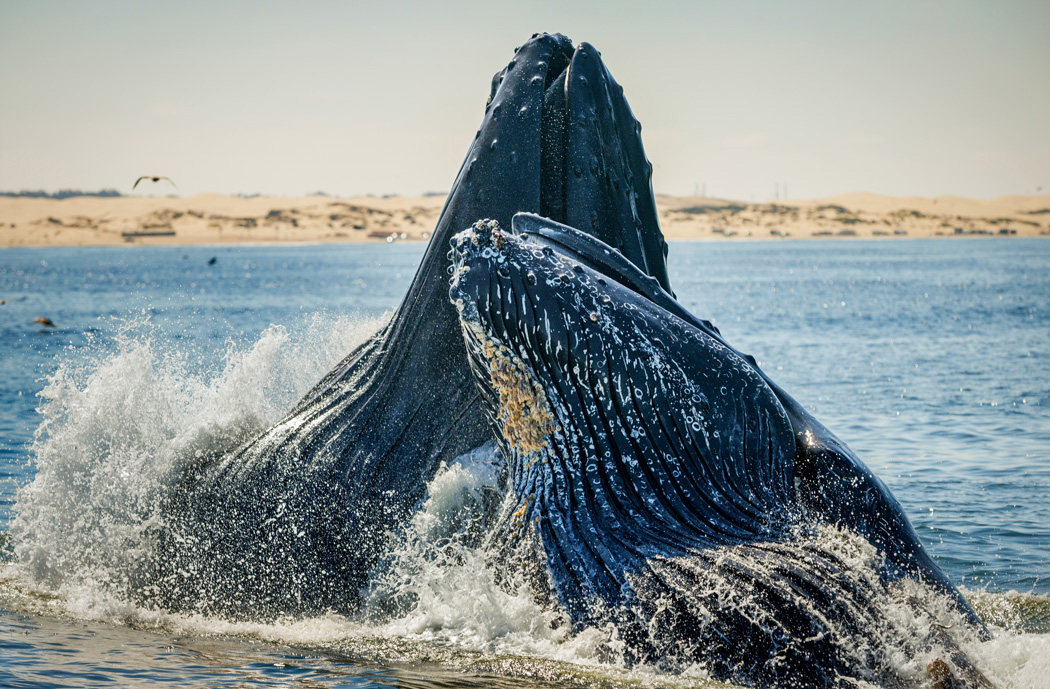
Bailey College research students, faculty and staff positioned passive acoustic monitoring instruments offshore along local coastal waters last August. After deploying the instruments more than three miles offshore, the group moved to a location near the Oceano Dunes in 50-70 feet deep water where they observed multiple pods of humpback whales feeding on large schools of anchovies. The whales worked together to herd the fish into concentrated balls followed by lunge feeding up through the schools.
Explore the Full Issue
Published as part of the Fall 2023 Issue of the Cal Poly Bailey College of Science and Mathematics Intersections Magazine.


