
Cool Walls and Green Buildings

Above photo: Chemistry research student Olivia Everitt operates a BYK Gardner Spectro-Guide Sphere Color Spectrophotometer. Photo by Alexis Kovacevic.
Chemistry and biochemistry team formulate coatings to reflect solar heat and lower building temperatures
For the past three decades, a wide variety of paint and coating products have helped to create eco-friendly “cool roofs” that reflect the sun’s rays and reduce excessive heat build-up. Researchers in Cal Poly’s Kenneth N. Edwards Western Coatings Technology Center (WCTC) are joining the industry’s growing green materials movement that focuses on “cool walls” to further lower building temperatures.
“There are thousands of coatings products for cool roofs, but only around 100-plus products out there for walls,” said Ray Fernando, WCTC director and the Arthur C. Edwards Endowed Chair in Coatings Technology and Ecology. “Knowledge needs to be generated to help encourage more industry manufacturing of new types of reflective coatings.”
New coatings can improve health conditions by preventing heat islands, urban areas that trap heat and experience significantly higher temperatures than surrounding areas. These elevated temperatures can cause heatstroke, heat exhaustion and respiratory difficulties. Heat islands can also lead to greater energy consumption — impacting peak energy demand — through increased use of air conditioning, contributing to the climate crisis. Solar-reflective coatings reduce building temperatures and counter the formation of heat islands.
“WCTC has over three decades of knowledge and experience in the science and technology of wall paints and coatings,” Fernando said. “Without this knowledge and experience, it is virtually impossible to conduct impactful research in cool wall coatings.”
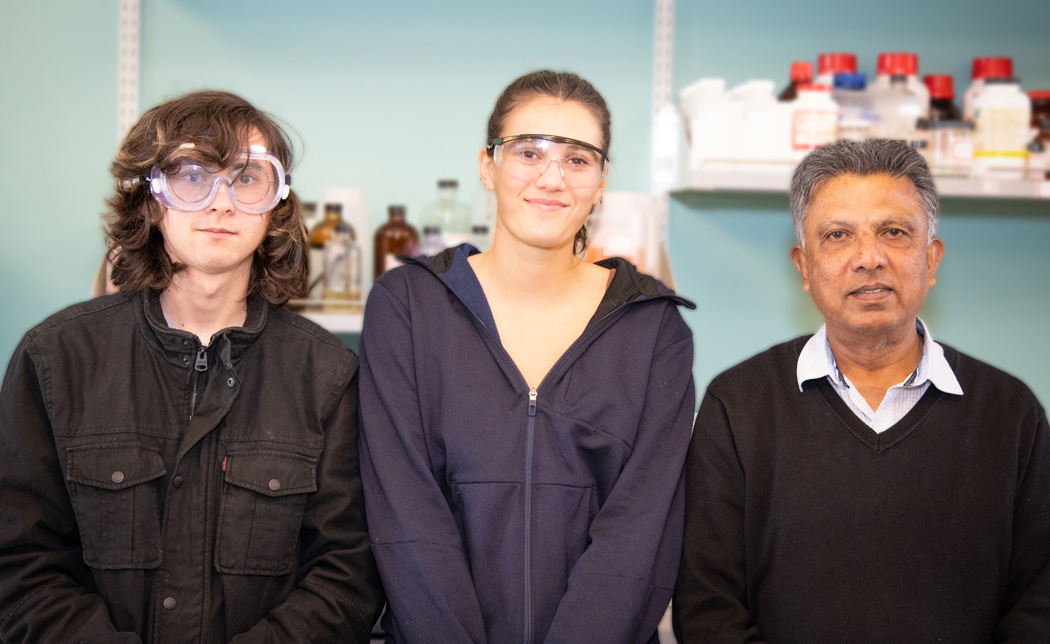
Fernando’s research team is exploring the underlying chemistry to create a range of new products from sealers and primers to pigments and paints. The team aims to formulate coatings that reflect solar heat in exterior walls and emit any heat that is absorbed. Most exterior wall coatings have traditionally been designed without optimizing for solar reflectivity — the amount of sunlight reflected by the surface. Instead, manufacturers pay greater attention to attractive colors and durability, qualities such as protecting against cracking and preventing mold and dirt from collecting, all important considerations for paint consumers.
While light-reflecting roofs are usually painted white to reflect light in the visible spectrum, the research team is taking their experiments in new directions exploring other colors, including black. The material compositions, including the size of the individual particles that make up the coatings, are designed to best reflect near-infrared light, which is invisible to the human eye. That allows consumers to enjoy the colors they’re accustomed to while still decreasing heat absorption.
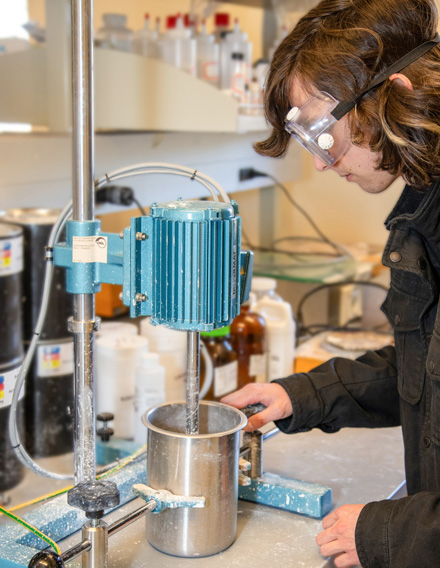
The team is also investigating thermochromic materials that change their color back and forth when heated or cooled. These coatings would absorb light in colder, winter seasons and reflect light in warm, summer conditions.
“Thermochromic materials will have a trigger temperature of 77 degrees, for example in one specific material, for reflection or absorption of light,” Fernando said. “Above 77 degrees, the material reflects light and below that temperature, rays are absorbed. We’re interested in materials with trigger temperatures in the range of about 75 to 85 degrees.”
The team’s next steps are to better understand particle sizes, costs and composition of coatings. Industry partnerships have made this research possible. The WCTC has a long and fruitful history of working closely with industry, and this project is no exception. Through a collaboration with Dunn-Edwards Paints, the Cal Poly team has access to equipment for measuring solar reflectance. Raw material supply companies have provided specialized materials to prepare coatings designed for solar reflectivity and absorption.
The WCTC is also now a member of the nonprofit Cool Roof Rating Council that rates a product’s radiative properties and publishes a list of cool roofs and exterior walls. The Portland, Oregon-based nonprofit, has invited Fernando to its annual meeting in June in Las Vegas to present the team’s results.
Student researchers have been involved in all aspects of experimentation and discovery. Lia Roccucci, who worked on the study and completed her blended bachelor’s in chemistry and master’s in polymers and coatings science in fall 2023, works for The Clorox Company’s research and development campus in Pleasanton, California.
One of the goals is to develop coatings that cannot only reflect heat in the summertime but also absorb heat in the wintertime.
—Lia Roccucci
(Roccucci completed her blended B.S. in chemistry and M.S. in polymers and coatings science in fall 2023)
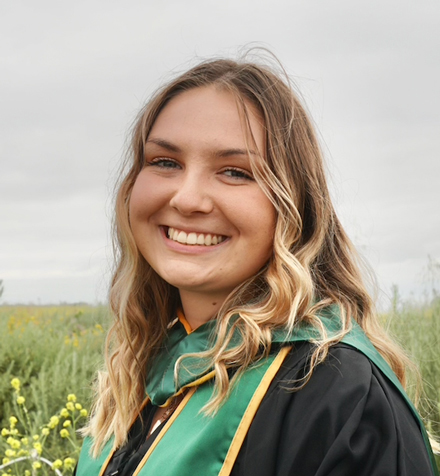
“A large part of my work has concerned the background academic literature review, looking at possible strategies and potential solutions for attacking this issue,” Roccucci said. “One of the goals is to develop coatings that cannot only reflect heat in the summertime but also absorb heat in the wintertime.”
Biochemistry senior Zacharie Danega, her Cal Poly lab partner, tested fillers (the substances added to paints to modify properties) of different particle sizes in coatings to optimize cooling. He found that smaller particles are better for visual properties, such as color hue and intensity, and larger particles are better for solar reflection.
Danega also had the opportunity to enter the world of professional chemistry as a student thanks to his research experience, attending the Western Coatings Societies Conference in Las Vegas in October 2023. “That was something I never expected,” he said. “I was able to participate in a program to shadow chemists because of the research.”
Danega’s travel expenses were covered by the WCTC, which also provided funding support for other students involved.
“There’s a lot of technology out there that we can explore to present our students with interesting opportunities that tie into today’s issues of sustainability and carbon footprint reduction,” Fernando said.
In turn, Bailey College students are using those opportunities to make an important contribution to climate solutions.
Research contact:
- Ray Fernando, rhfernan@calpoly.edu
Read this group's research publications:
Funding contributors to this research:
- Golden Gate Society for Coatings Technology
- Arthur C. Edwards Endowment
- Kenneth N. Edwards Western Coatings Technology Center
Learn more about the Kenneth N. Edwards Western Coatings and Technology Center
Explore the Full Issue
Published as part of the Spring 2024 Issue of the Cal Poly Bailey College of Science and Mathematics Undergraduate Research Magazine.


