
Cameron Corley: Physics Student Inspired by Unsolved Questions of the Universe
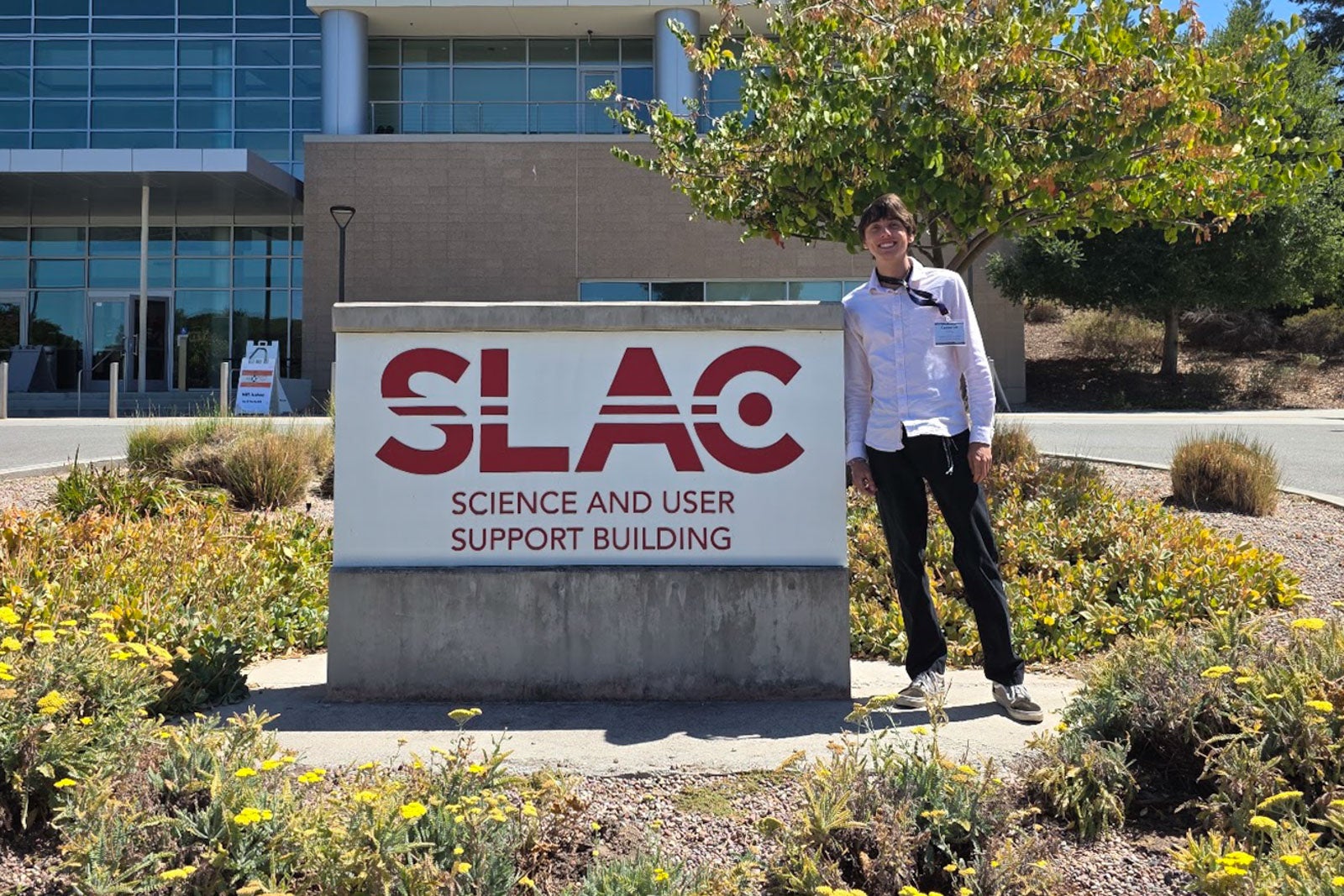
Cameron Corley is a fourth-year physics student who finds the larger questions of the universe fascinating.
He has participated in research with Physics Professor Ben Shlaer, tackling complex theories of astrophysics yet to be proven. Separately, Corley is now collaborating with Professor Louise Edwards on a study using deep space data emerging from the Vera C. Rubin Legacy Survey of Space and Time to assess the formations of galaxies.
I want to learn things that no one has learned before.
— Cameron Corley
Growing up in Castro Valley in Alameda County in the Bay Area, the son of biologists, Corley was a fan of science fiction and enjoyed contemplating the wonders of space. In school, he enjoyed learning about science and math, which came naturally to him. So, when considering his college major, he could have taken various paths. But Corley landed on physics and astronomy as his minor.
“I decided on physics because it has the most math of all of the sciences,” Corley said. “Math is the language of the universe and explains how things work. I enjoy learning about mechanisms and forces in the world, and, of course, space. I want to learn things that no one has learned before.”
This Fall semester, Corley is taking physics courses, including Observational Astronomy and Electromagnetic Fields and Waves. And in the spring, he plans to enroll in Classical Mechanics II (math/physics) and Introduction to Special and General Relativity (physics).
Corley admits to being intimidated by how to get involved with research early on at Cal Poly. But he was interested in exploring the options, so he took a one-unit course titled “Introduction to Physics Research.”
“Once a week, they’d have a professor come in and talk about what they're working on,” Corley said. “I didn’t think you could just join a group. But I met with a professor to learn more about how research works. The professor encouraged me to just email the professor, and ask them about what they’re doing, saying ‘They love to talk about it.’ And that’s how I connected with Dr. Shlaer.”
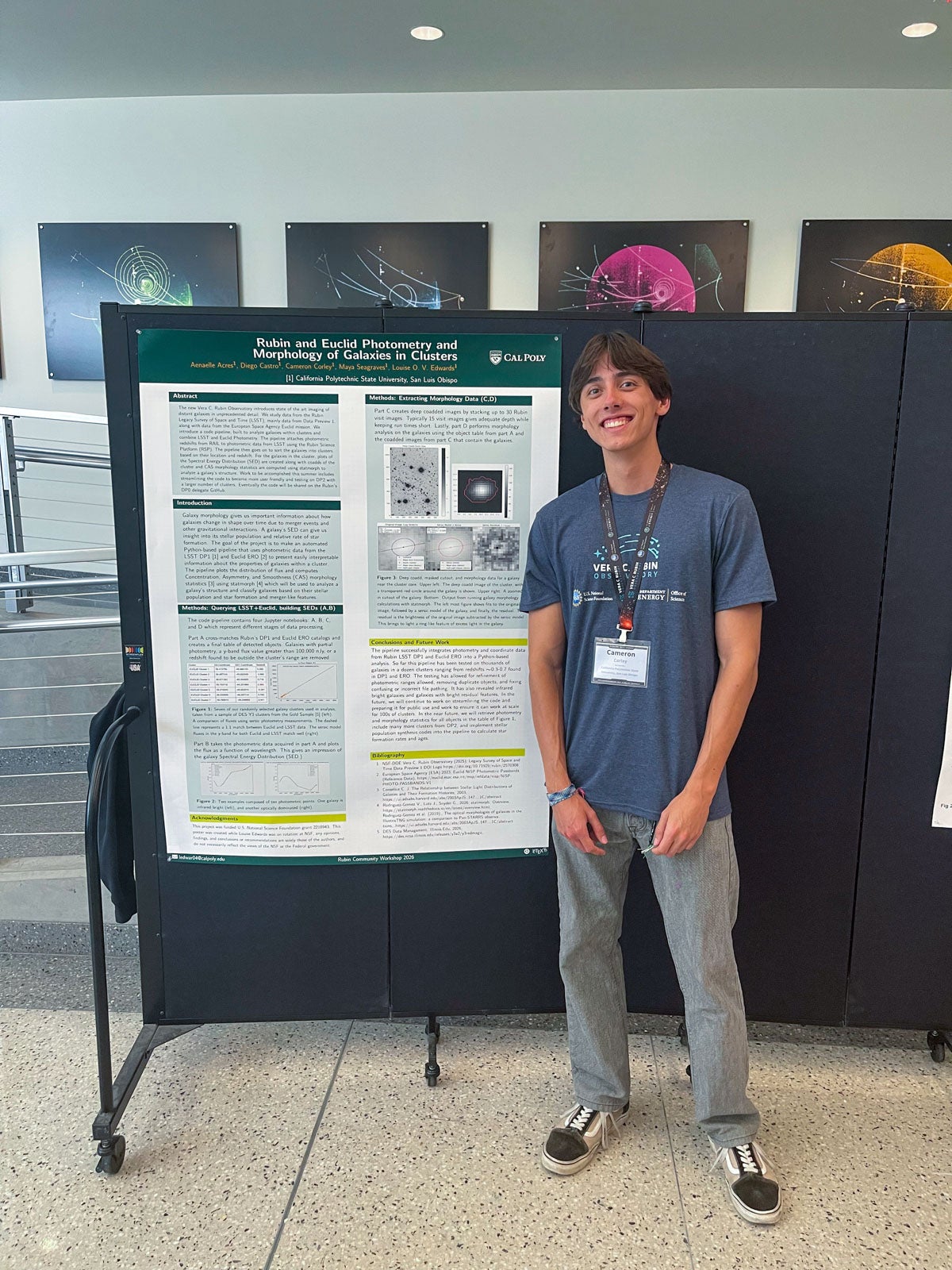
Through the two research projects that he has participated in, supported by the Frost program (Shlaer’s study) and the U.S. National Science Foundation (Edwards’ study), Corley has also discovered a passion for exploring, learning, and innovating.
He co-authored a journal article titled “Geodesic completion of big bangs from emergent geometry” and attended two academic conferences in Denver (APS Global Physics Summit 2026) and Menlo Park (Rubin Observatory Community Workshop at SLAC). Corley honed new skills in creating computer code to assess large datasets from the Legacy Survey of Space and Time.
“It’s easy to sink into research and spend a lot of time doing it because it’s so fun,” Corley said.
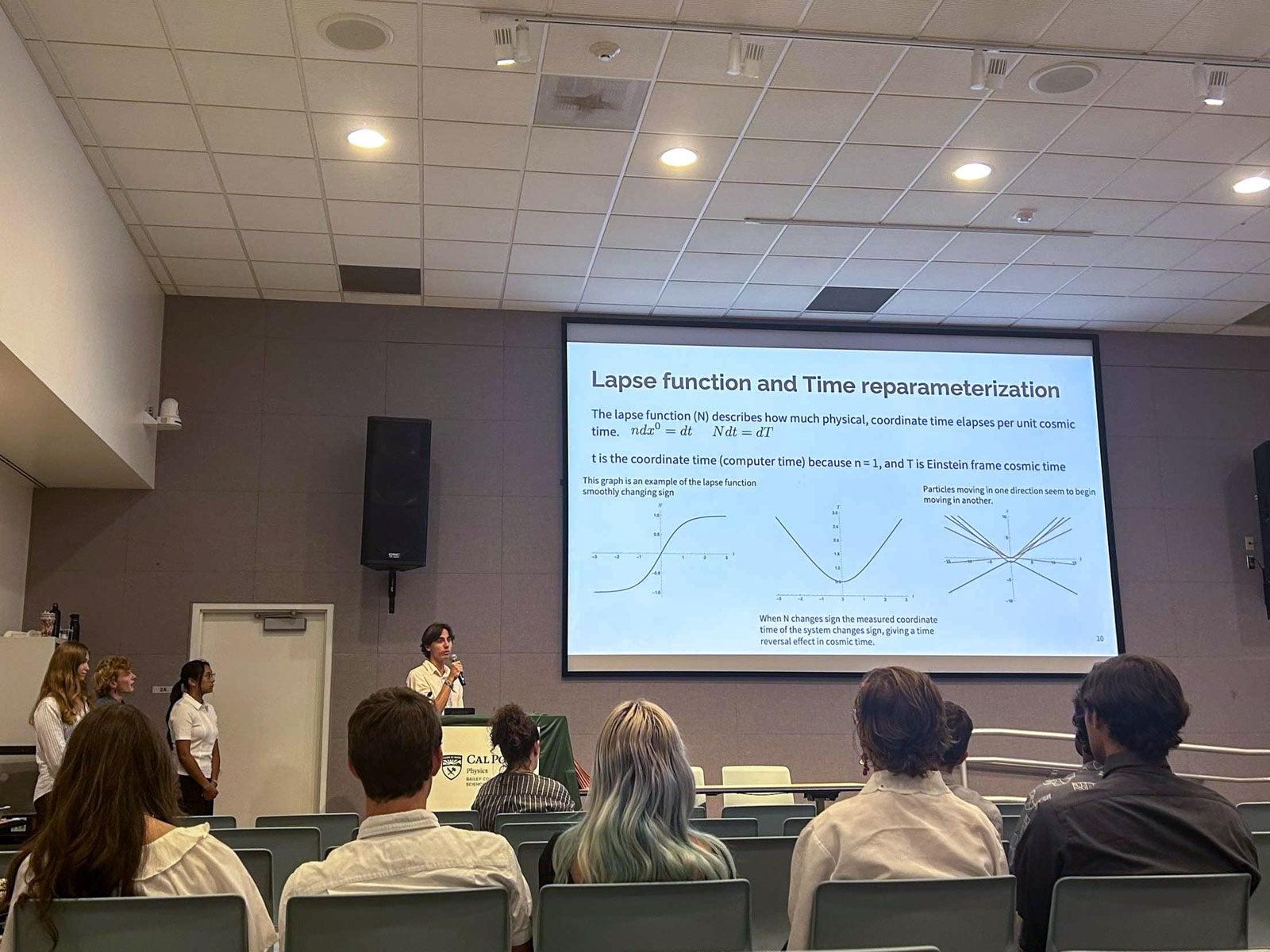
Corley used principles rooted in theoretical physics and mathematical cosmology with Dr. Shlaer. Through that research, Shlaer and students explored how adding Chaplygin gas to the universe would change space-time.
While there’s no direct evidence of Chaplygin gas in the universe, the theoretical concept introduced by physicists draws upon the mathematics of Russian scientist Sergey Chaplygin, which unifies dark matter and dark energy into a single substance and helps explain the accelerated expansion of the universe that we observe today.
Corley's research with Dr. Shlaer attempts to explain a time reversal property leading to contraction of the universe, which proposes an idea for what could have happened before the Big Bang.
“Hypothetically, if you slip the Chaplygin gas into the action, which is the formula for the universe, what you get changes the expansion rate of the universe,” Corley said. “At first, it was mainly Dr. Shlaer just teaching us because it’s too advanced for our student group’s skill level. But it was fun to be a part of and eventually we were able to contribute some ideas.”
As a researcher with Dr. Louise Edwards, Corley’s work is based on astronomical observations and creating computer code to craft tools for exploring deep space.
The decade-long astronomical survey project, launched in June, offers new high-definition perspectives on distant pockets of the universe captured from the Vera C. Rubin Observatory in Chile. The project will help astronomers address questions about the nature of dark matter and dark energy, mapping the Milky Way, investigating objects that change position or brightness over time, and creating an inventory of the Solar System.
Corley’s work involves studying colors, shapes, and distances of faraway galaxies from Earth.
“Within the code I wrote, you get the redshift of the galaxies and the galaxy clusters,” Corley said. “The galaxies that are further away become red in their color and generally more elliptical, and shaped less like discs, because the discs formed later in the universe. Using the tools we created, I can look and say, ‘How many of these galaxies are circular or elliptical? How many are more red or more blue?”
Corley has enjoyed delving into both theoretical and experimental physics, rather than choosing one early in his college career.
“I’m wanting to figure that out now, especially before applying to graduate school,” Corley said. “Experimental research shows what’s actually present in our universe, and that’s really fascinating. But the ideas behind things like what happened before the Big Bang, and whether time can reverse, those are extremely interesting too.”
Corley thinks both fields are important and offer engaging challenges as he leans toward a focus on experimental work.
“I think it would be most fun to be able to work with some of those (theoretical) ideas, but mainly be contributing to an experimental project, just because there's actually a tangible result, and I think sometimes I need that actual result to feel like I'm doing something more important versus testing mathematical theories that could explain what might be possible,” Corley said.
Whichever direction he chooses, Corley’s Cal Poly experience has opened doors to exciting opportunities that he previously didn’t think were possible at his level of education.
“I didn’t think I'd be able to do this kind of work in college,” Corley said. “I thought you had to be a lead researcher or in a Ph.D. program. I’m glad that I chose Cal Poly because the Physics program has a good faculty-to-student ratio, and there are plenty of chances to delve into a research project.”


