
Cal Poly Astronomy Researchers Explore Cosmos in High Definition
Researchers Explore Unparalleled Wide-Field Images from Sweeping Survey
The long-awaited arrival of some of the most detailed, distant and comprehensive images of the night sky is offering Cal Poly astronomy researchers the opportunity to engage in fascinating, cutting-edge research through a global science project.
From a mountaintop in Chile, the Vera C. Rubin Observatory is now capturing revealing new images of the southern sky about every 40 seconds, using the world’s largest digital camera — a 3.2-billion-pixel instrument. Supported by funding from the U.S. National Science Foundation and the U.S. Department of Energy, the Legacy Survey of Space and Time (LSST) will assemble the most sweeping astronomical dataset in human history.
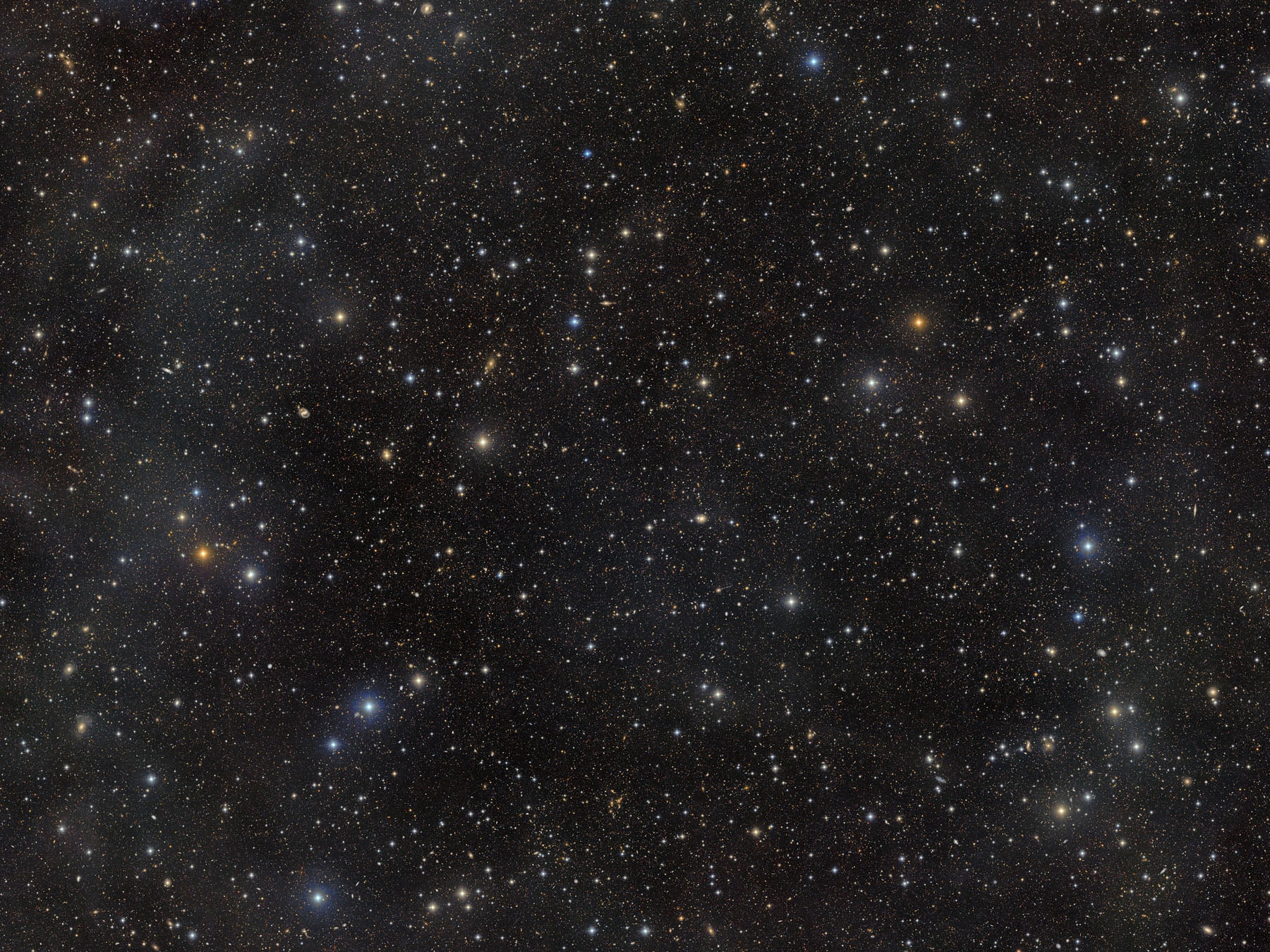
Cal Poly Physics Professor Louise Edwards and her student research team are investigating the treasure trove of new information since the legacy project’s launch in June. Over the next decade, the survey will cover the entire sky every few nights, creating an ultra-wide, ultra-high-definition time-lapse record.
“What’s happening is the entire sky gets covered every three days, and then they do that over and over and over again,” Edwards said. “They'll do it for 10 years, but every year they'll release the data. So, what you get every year is a movie of how everything in the sky has changed for that year. No one astronomer could have built this instrument and invested the kind of money this takes, so it’s a dream for us to get this kind of data.”
The project, named after the late American astronomer Vera Rubin, offers opportunities for scientists worldwide to make discoveries including new galaxies, pulsating stars, explosions, the fossil record of galaxies and clues to dark energy and dark matter.
“This has been one of the top astronomy projects in the works for the last decade, and it’s finally online,” Edwards said. “It has taken so long to get to this point, and to now be collecting real data is very exciting.”
Edwards is currently serving the final year of a three-year term as a program director with the National Science Foundation’s Section of Astronomical Sciences. In 2022, she won an NSF Astronomy and Astrophysics Research and Education (PAARE) grant and an NSF Astronomy and Astrophysics Grant (AAG) award which combined to more than $1 million to use data from the Rubin project for research purposes.
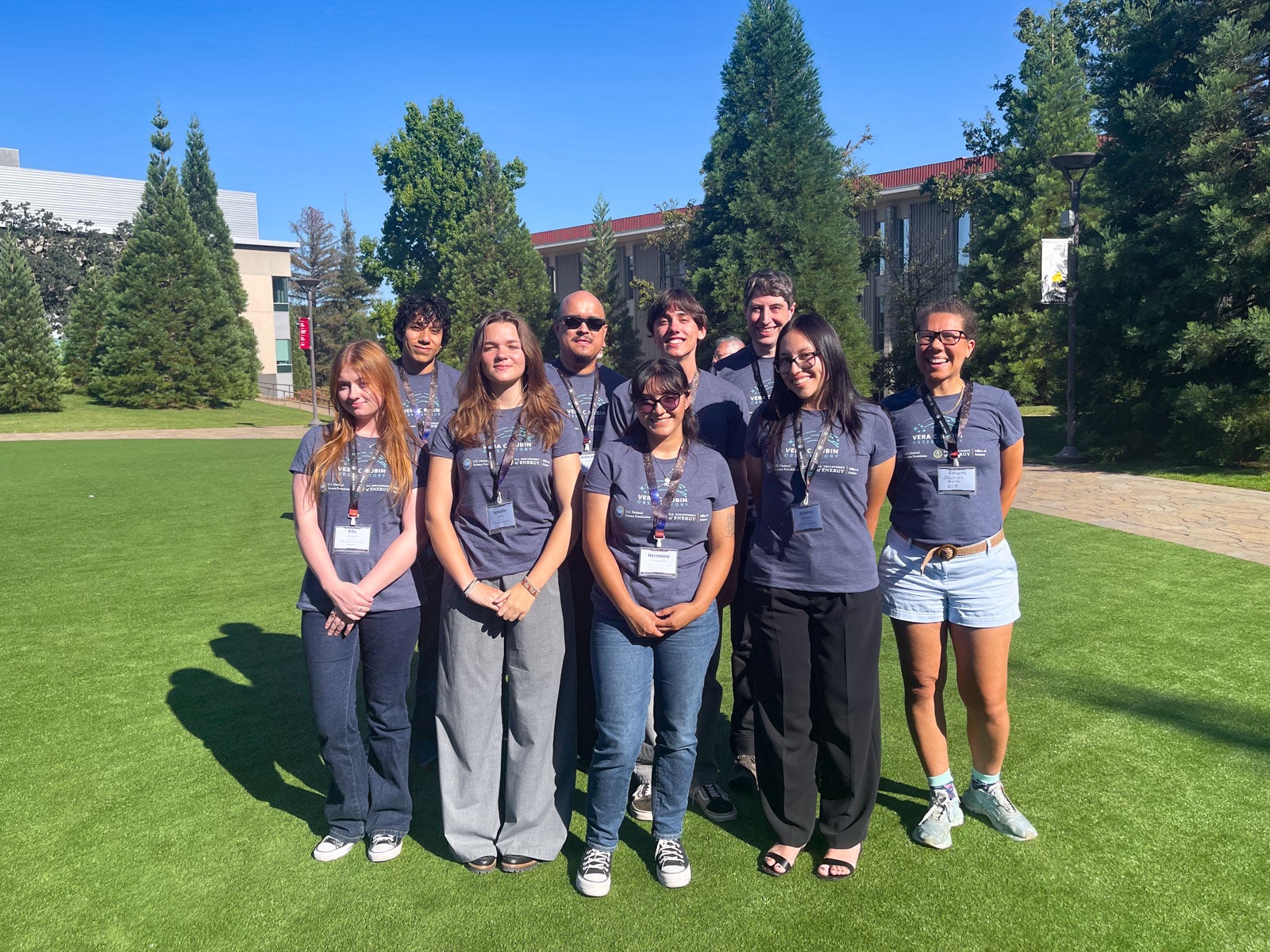
Cal Poly and three other California State University campus — CSU Stanislaus, San Diego State and Cal Poly Pomona — are collaborating as part of the grant that has already involved 40 undergraduate students over the course of the five-year study, along with four professors who meet each summer for a week-long workshop that includes science and professional activities. In late July, Cal Poly students and Dr. Edwards attended the Rubin Observatory Community Workshop at the SLAC National Accelerator Laboratory in Menlo Park where they shared ongoing work and reviewed the latest data releases from the LSST project.
Cameron Corley, a Cal Poly fourth-year physics student (earning an astronomy minor), who’s collaborating with Edwards is impressed with the camera’s resolution: “That's really important for seeing the shapes and structures of these faraway galaxies. One of our main goals is called galaxy morphology, which is looking at shape and structure to learn how they’ve evolved."
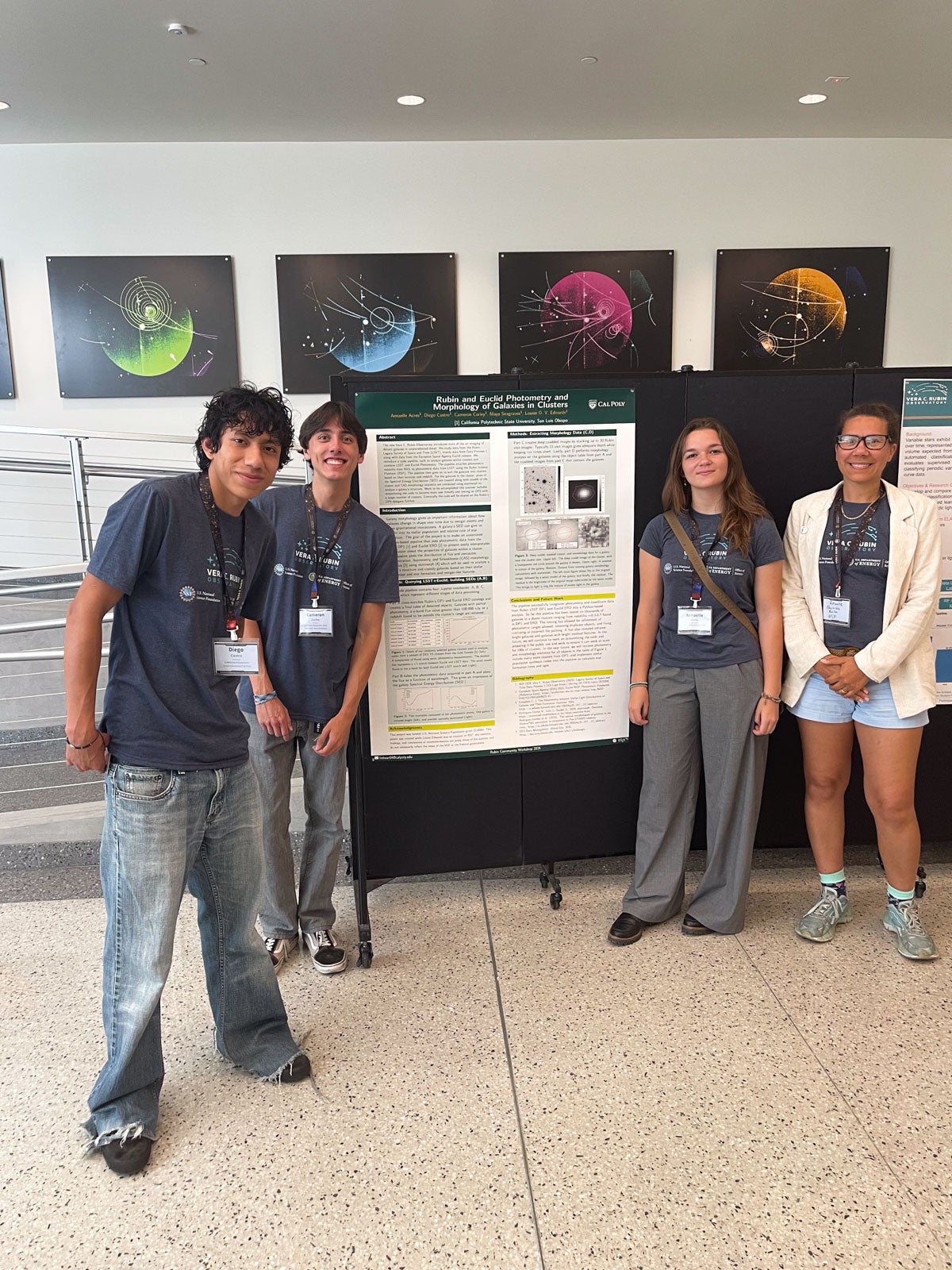
The Cal Poly team’s research primarily involves crafting the computer code to process astronomical data, focusing on specific observations. Over the past five years, with the CSU researchers, Edwards and her students have worked on preparing their computer programs to manage large amounts of data in preparation for the actual imagery now coming in. Their computer technology processes information as it comes through so they can best study the results.
“We've used those simulations to build up all of our pipelines, all of our computer programs, and we get to run them on this real data,” Edwards said. “We had to learn new computer languages and build our own computer codes. That’s much easier to practice if you’re practicing on images that look real, like what you would expect them to look like.”
Edwards said that the promise of the project could offer exciting learning opportunities for scientists because of the ability to observe phenomena that wasn’t possible before: “If we want to learn more about cosmology, the size of the universe, the shape of the universe, the nature of dark energy, dark matter, all of that hinges on observations of changing objects, like supernovae, for example. This survey is going to be the key because it’s observing more, fainter objects than we can simultaneously obtain with any other instrument on the Earth or around the Earth.”
Observation of faint lights captured over the duration of the project will allow Edwards’ research team to plot frames of the same areas of the sky over one another to get an extra deep image of the same section of the sky. That may help find out more about certain galaxy formations and cosmic evolution.
“You're going to capture faint light for two reasons: either because the light is naturally faint, this kind of ghosty light, or because you're looking so far away that things just look really faint because they’re so far away,” Edwards said. “My group is interested in this sort of ghostly light, this very faint light that other telescopes can’t see. It looks like there’s nothing there unless you stare at it for long enough. Every year, with every new release, we're going to be able to see that kind of light deeper and deeper into the universe and further back in time.”


