
AI: It Can Inform, But Can It Connect?

Artificial intelligence has the ability to revolutionize how we consume information, but whether generative AI is the best way to influence public health behavior remains in question.
Students Sofia Ramos (Biological Sciences, ’26) and Frost Research Scholar Lauren Sandoval (Public Health, ’24) worked with Julia Alber, a professor of public health, to publish “AI Awareness and Tobacco Policy Messaging Among U.S. Adults: Electronic Experimental Study.”
Their quest involved trying to find out whether audiences responded positively or negatively to AI-generated videos used as a tool for tobacco use prevention.
“It was hard to find data on this topic because the AI usage in our field is so new,” Alber said. “We wanted to explore whether this could be an effective way to deliver health messaging considering that if you want to make a high-quality video, it’s very difficult to do it on your own, and it can be expensive to hire a marketing company.”

To gauge audience response, the survey involved a sample of 500 U.S. adults, using a Qualtrics Survey Panel, involving voluntarily participants in research. Data was collected between Jan. 25 and Feb. 1, 2024, with a mean survey participant age of 48 years old and a roughly even number of men and women.
Participants were shown the same AI-generated video with the narrator telling a story about how addiction to flavored vapes started and controlled the person’s life. The video concluded with display promoting the end of flavored tobacco sales.
The same video was shown to all viewers, who were told one of four things: 1) the narrator was AI-generated, 2) the narrator was human, 3) it was unknown whether the narrator was AI or human, or 4) they were not provided any information about the video.
Researchers used statistical software to analyze responses, including whether participants perceived the messaging to be positive or negative, convincing, informative and genuine. And they were asked if they felt the voice sounded monotone or human.
“We had an idea about what the findings would show, but that turned out differently than what we expected,” said Ramos, a BEACoN program research scholar. “It was very useful for me to conduct research in observational science on public health as my career goal is to become a physician’s assistant.”
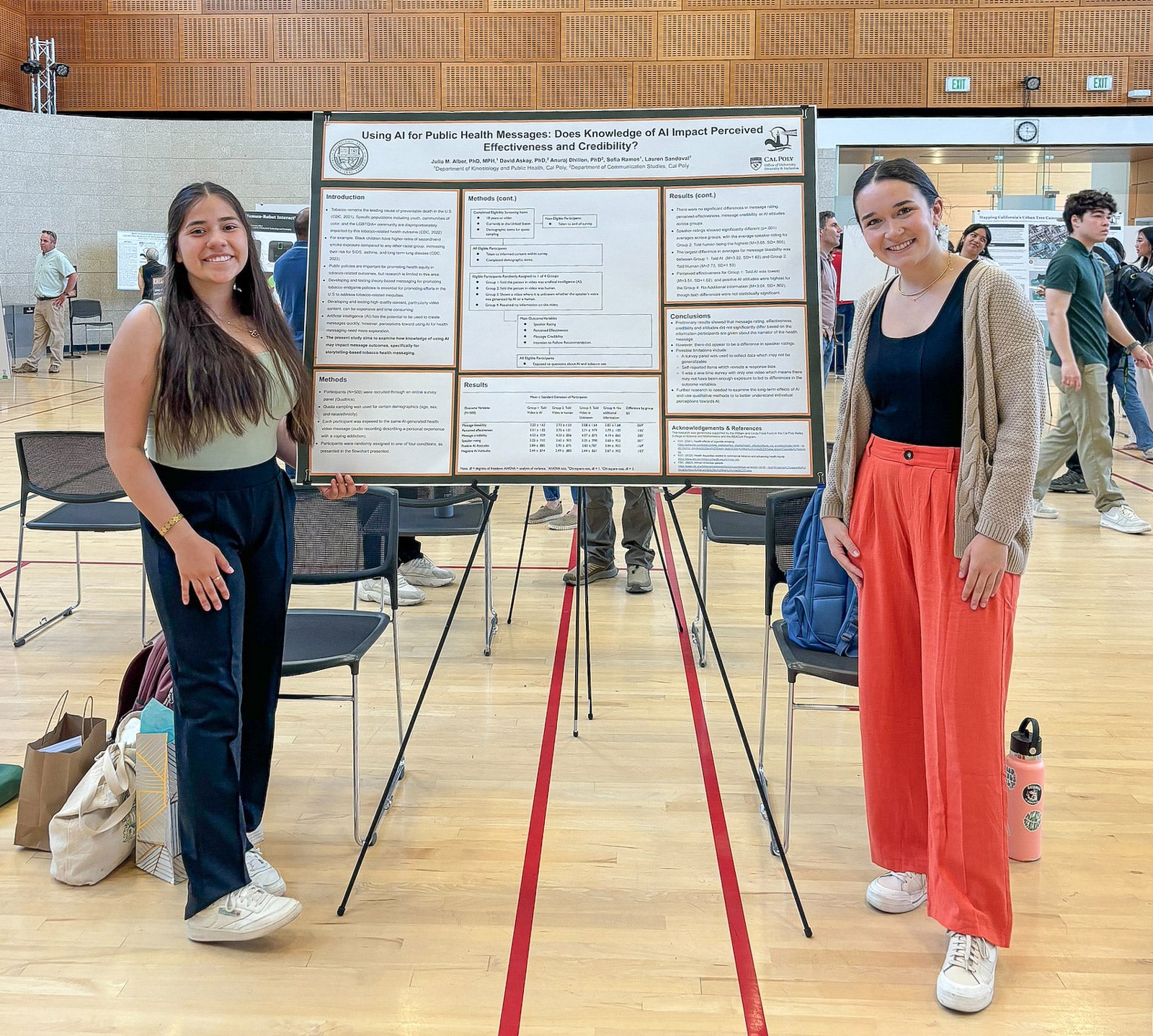
The group hypothesized that those informed of the AI-generated narrator would rate the video lower on perceived effectiveness and credibility, but that wasn’t the case.
Rankings of survey respondents determined that viewers generally found the messaging credible whether they believed the voice to be AI-generated or human.
“Participants across conditions frequently described the video as ‘informative,’ indicating that high-quality messaging can resonate with audiences, regardless of the narrator’s perceived identity,” the article noted.
But results showed roughly 12% higher average speaker ratings when people believed the narrator was human instead of AI.
“Speaker ratings are used in health communication to determine if someone is believable, caring, smart, competent and ethical,” Alber said. “In our study, the only thing the viewers didn’t like was thinking the speaker was AI versus human.”
Comments included: “The voice is monotone and dead. Creepy” and “you could tell it was AI spoken.”
Ramos said that she personally found it interesting that the viewers felt disconnected from an AI narrator.
“Everything in the video is what a real person would say,” Ramos said. “But the human connection is lacking and that human connection is really important.”
More research is likely needed to determine if AI messaging may be useful or not when it comes to effective public health outreach with constrained budgets for marketing campaigns.
The journal article states that “despite public health efforts, tobacco use remains the leading cause of preventable death in the United States and continues to disproportionately affect underrepresented populations.”
Sandoval, now an administrative associate at the Stanford Cancer Institute, recalls the benefit of learning how to analyze data, including assessing qualitative data.
“We would code in categories with the same or similar responses,” Sandoval said. “I thought that it was interesting how the speaker rating changed. It makes sense to me because I think there is some apprehensiveness in regard to using AI. It’s so important for people to trust the messenger and for researchers to continue researching and using these findings as a steppingstone.”
The study notes that future studies might explore whether message outcomes differ over time with multiple exposures to different types of videos and compare different AI visuals, such as avatars, graphics or cartoons, to determine likability across technologies.
“There’s a lot of potential to use AI in public health because there are times agencies need to act quickly, such as with COVID-19 response,” Alber said. “Or there may be a need to issue public health messages in Spanish or to connect with a specific dialect for a specific population. Generative AI can do that now.”
This work was supported by funding from BEACoN (Believe, Educate & Empower, Advocate, Collaborate, Nurture) Research Scholars Program; William and Linda Frost Fund.

Explore the Full Issue
Published as part of Milestones, a special commemorative issue magazine from the Cal Poly Bailey College of Science and Mathematics in 2026.


